
Ubatuba's beaches and their blue waters
Those who visit Ubatuba often notice something that immediately catches the eye within the first few minutes on the beach: the blue or blue-green hue of the sea. Compared to other regions of the São Paulo coast—especially the southern coast—the waters at Ubatuba's beaches appear clearer, brighter, and, depending on the beach, almost transparent. This is not just an impression: there are well-defined natural reasons for this phenomenon. What are they?

1. Less influence from large rivers and sediments.
The southern coast of São Paulo receives the discharge from extensive and voluminous rivers, such as the Ribeira de Iguape, which transport large quantities of organic and mineral sediments (this river crosses Paraná and São Paulo for 470 km, originating in the Paranapiacaba mountain range and flowing into the Atlantic near Iguape) . These materials remain suspended in the water, absorbing and scattering light, leaving the sea with a darker or greenish color.
In Ubatuba, the situation is different. The rivers that flow into its beaches are short, with small drainage basins and limited flow. As a result, less sediment reaches the sea, allowing sunlight to penetrate more deeply—which intensifies the shades of blue.
It is worth noting that heavy rains can temporarily leave parts of the sea with shades of brown or gray, depending on the sediments carried by local rivers.
2. Serra do Mar nearby and preserved vegetation.
The city is nestled against the Serra do Mar mountain range, one of the most preserved areas of the Atlantic Forest in the country. This vegetation acts as a natural filter: it reduces erosion, holds the soil, and prevents large volumes of earth from being carried to the rivers and then to the ocean.
On the southern coast, where there are extensive plains, mangroves, and older (and larger, like Santos) areas of human occupation, the transport of organic matter to the sea is greater, directly influencing the color of the water.
3. Favorable ocean dynamics
The beaches of Ubatuba are more exposed to ocean currents coming from the open Atlantic. The sea off Ubatuba receives these currents, which bring cleaner waters with less sediment, especially on calm sea days and after the passage of cold fronts.
The southern coast, on the other hand, is more protected by wide coves and estuaries, which facilitates the accumulation of suspended particles and reduces the constant renewal of the water.
Ubatuba has greater direct exposure to oceanic influence (Brazil Current), with its warm surface waters. and clearer waters , while the southern coastal region is more influenced by coastal waters and its proximity to Santos Bay , resulting in less transparency.
4. Type of seabed
On many beaches in Ubatuba, the seabed is made up of light-colored sand and rocks. This type of substrate reflects sunlight better, contributing to the turquoise-blue appearance on sunny days.
On the southern coast of São Paulo state, the seabed tends to be muddier and richer in organic matter, especially near channels and river mouths, visually darkening the water.
Ubatuba is characterized by deeper waters closer to the coast, a rocky bottom, and fine sand , while the southern coast is marked by shallow waters, a wide continental shelf, and predominantly muddy and fine sandy bottoms .
5. Lower urban and industrial pressure
Another important point is the absence of large port and industrial complexes near Ubatuba. Regions such as Santos, Cubatão, and areas adjacent to the southern coast have historically been influenced by industrial activities, ports, and intense urbanization, which alters the composition of coastal waters.
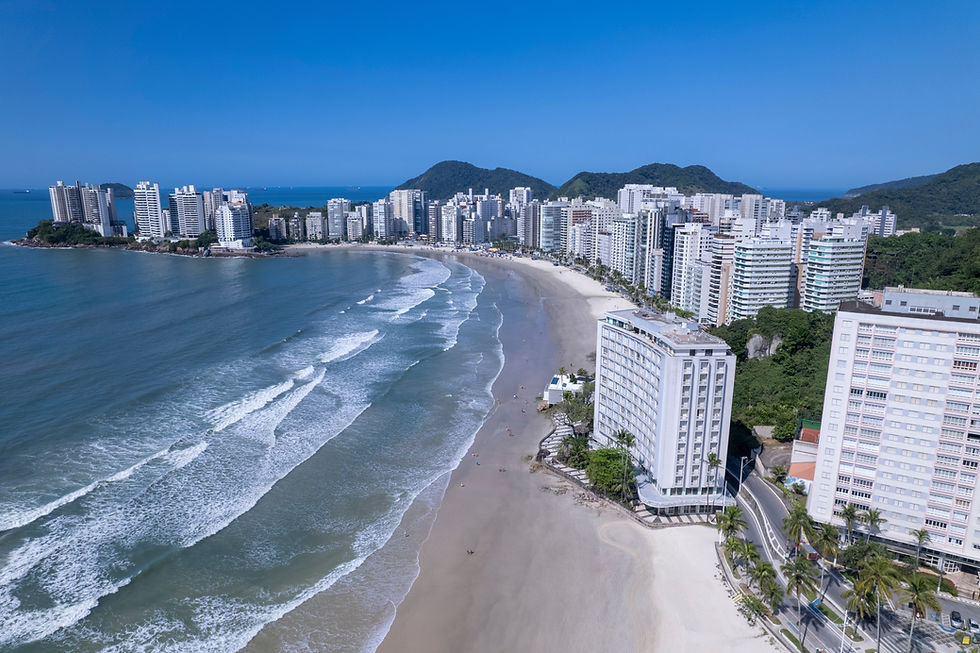
Pitangueira Beach in Guarujá is an example of a beach with darker waters.
In Ubatuba, the Serra do Mar State Park occupies 80% of the municipality and is the largest area of preserved Atlantic Forest in the country, with more than 332,000 hectares of protected nature. The Picinguaba Nucleus , one of the most special areas of the park, creates a unique landscape where the mountains descend to the sea, uniting mountain, forest and coastline in a single destination.

Ubatuba's beaches: A changing blue, but always impressive.
It's important to remember that the sea is a living system. Winds, rain, swells, and tides influence the water's color daily. Even so, due to a combination of geographical, environmental, and oceanographic factors, Ubatuba maintains, most of the time, one of the bluest seas, often with greenish and visually appealing tones, along the entire coast of São Paulo.
In summary:
Ubatuba beaches | Beaches of the South Coast of São Paulo | |
Water color | Shades of blue and blue-green, often lighter and more translucent. | Darker, greenish or brownish tones at various times |
Influence of rivers | Short rivers with low flow rates and low sediment load. | Presence of large, fast-flowing rivers, with high sediment transport. |
Amount of sediment in the water | Low, allowing for greater penetration of sunlight. | High, making the water more turbid. |
Proximity to the Serra do Mar mountain range | The Serra do Mar mountain range is very close to the coast, with steep slopes. | A more remote mountain range, with extensive plains. |
Vegetation cover | Dense and well-preserved Atlantic Forest extending almost to the coast. | More fragmented vegetation, with mangroves and flooded areas. |
Soil erosion and transport | Less erosion due to preserved forest. | Increased transport of organic matter and sediments. |
Ocean dynamics | Greater influence of open ocean currents | Waters that are more protected and less renewed. |
Seabed | Predominantly light-colored sand and rocky areas. | A muddy bottom, rich in organic matter. |
Water renewal | More frequently, keeping the sea visually clean. | Slower, favoring the accumulation of particles. |
Urban and industrial pressure | Reduced presence of large industrial centers. | Historical influence of ports and industrial areas |
Visual perception for the tourist | The sensation of a clean, natural, and preserved sea. | The sea feels darker and more turbid in many sections. |
It is this combination of preserved nature , privileged geography , and dynamic ocean that makes Ubatuba such a special destination, causing the beaches of Ubatuba to stand out not only for their beauty but also for the environmental quality that is perceptible at first glance.



Comments